How to write an AI acceptable use policy for a small company
An AI acceptable use policy tells staff which tools, data and tasks are allowed. Here is what to include, a one page structure and a seven step rollout.
By the Wopie team · November 5, 2026 · 9 min read
Listen to the summary· 1 min
An AI acceptable use policy is a short written set of rules that tells your staff which AI tools they may use, what data they may put into them, which tasks need a human check, and who to ask when something is unclear. If you run a small company, you can write a useful AI acceptable use policy in an afternoon. It needs about eight parts and one to two pages.
The most important parts are a list of approved tools, a simple sort of your data into what may and may not go into AI, and a rule that a person reviews anything sent outside the company. The rest of this guide shows what to put in each part, how to roll it out in seven steps, and how to keep it alive. It is general information, not legal advice, so have a lawyer check it if you handle regulated data.
Why does a small company need an AI acceptable use policy?
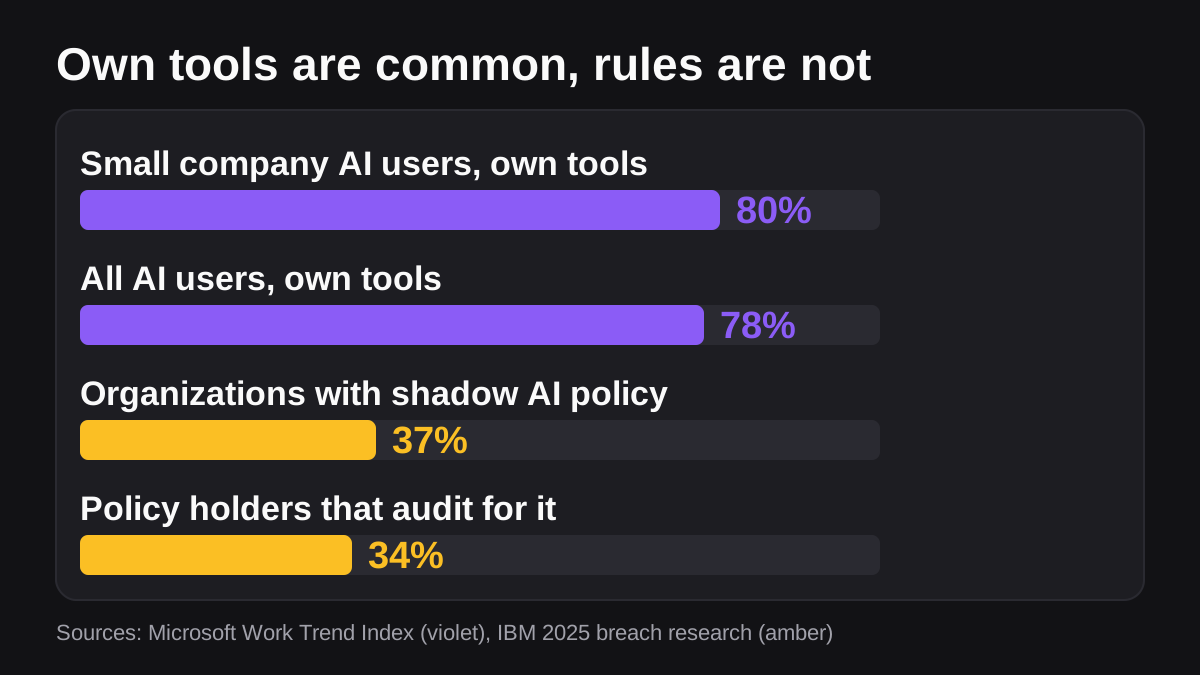
Because your staff are already using AI, with or without a rule. Microsoft's Work Trend Index found that 78% of AI users bring their own AI tools to work, and that it is even more common at small and medium-sized companies, at 80% [4]. The survey covered 31,000 knowledge workers in 31 markets [4]. So at a company of any size, the real choice is not between AI and no AI. It is between AI you can see and AI you cannot.
The cost of not seeing it is measurable. IBM's 2025 breach research, which studied 600 organizations, found that one in five reported a breach due to shadow AI, meaning AI used without approval [3]. Organizations with high levels of shadow AI paid an average of $670,000 more per breach than those with low or no shadow AI [3]. Only 37% had policies to manage AI or detect shadow AI [3]. Among the breached organizations, 63% either had no AI governance policy or were still developing one [3].
What does a real leak look like?
In 2023, Samsung found that internal, sensitive data had been accidentally leaked to ChatGPT. It then restricted generative AI on company devices and on personal devices connected to its internal networks. It called the restriction temporary, in place until it could build security measures for safe use [5]. Samsung said data sent to outside AI servers is hard to retrieve and delete, and could be disclosed to other users [5]. Nobody was attacking Samsung. Staff were trying to work faster.
What should an AI acceptable use policy include?
The Michigan Small Business Development Center lists the core topics: protecting sensitive and confidential data, which data types may be used with AI tools, which users can access the AI and the systems it connects to, regulatory compliance, end user training on security and privacy, consequences for violations, and a process for requesting new AI tools [6]. It describes this as a good foundation, not an exhaustive list [6]. It also advises building the policy around your overall AI approach rather than one tool, since tools change and frequent rewrites are a burden [6].
Here is how those topics turn into sections you can write today.
| Section | What it says in plain words | Example line |
|---|---|---|
| Purpose and scope | Who the policy covers and which tools | Applies to staff, contractors and any AI feature inside a tool we use |
| Approved tools | The short list of sanctioned tools and who may use them | Approved: the tools on the register. Everything else: ask first |
| Data rules | What may and may not go into AI | Never paste customer personal data or passwords into a tool that is not approved for it |
| Human review | What a person must check | A person reads anything that goes to a customer, a regulator or the public |
| Connected access | What an AI tool may read or change in your systems | Agents get read access first. Sends and spend wait for approval |
| Training | What staff must learn | A thirty minute session at onboarding and once a year |
| Reporting | What to do when something goes wrong | Tell the policy owner the same day, no blame for honest mistakes |
| Consequences and changes | What happens on a breach, and when the policy is reviewed | Reviewed every six months or when a new tool is added |
Why name an owner?
NIST's AI Risk Management Framework is voluntary guidance for managing AI risk [1]. Its Govern guidance says roles, responsibilities and lines of communication for AI risk should be documented and clear [2]. In a ten person company that means one name at the top of the policy. Without one, nobody answers the "can I use this?" question, and people guess.
How do you decide what data can go into AI tools?
This is the part of the policy people read most, so make it easy to apply in a few seconds. Sort data into three tiers, like traffic lights.
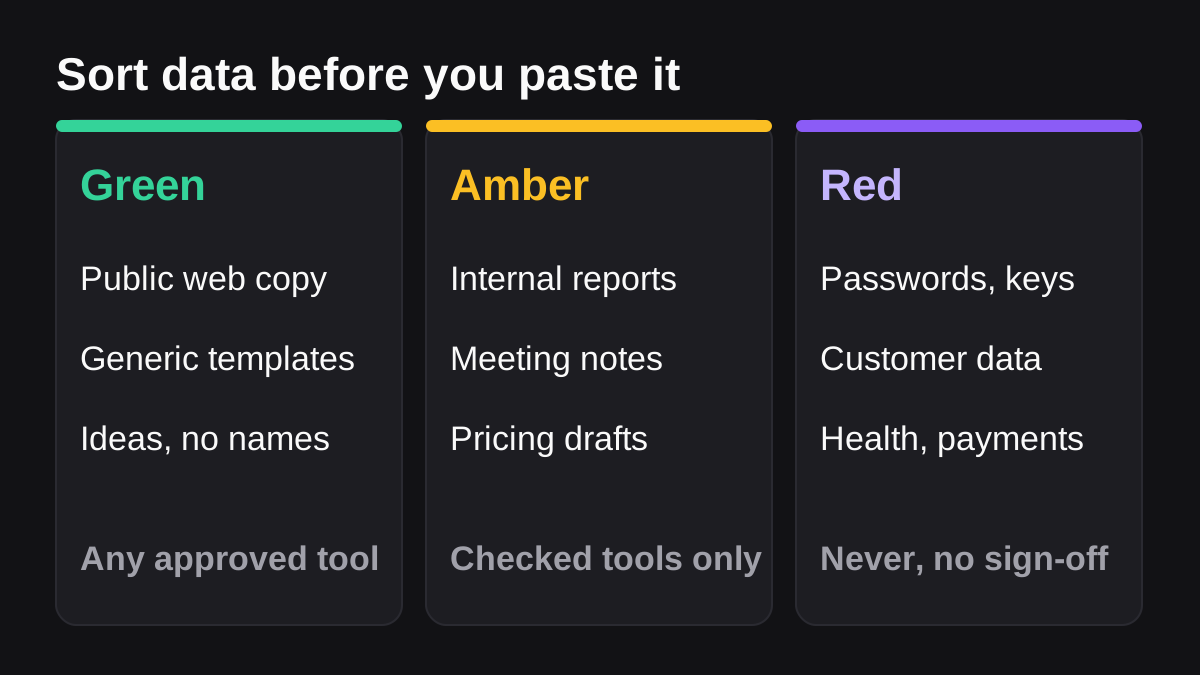
- Green: public or low risk. Published web copy, generic templates, your own draft ideas with no names. Staff may use any approved tool.
- Amber: internal but not secret. Internal reports, meeting notes, pricing drafts, customer company names. Allowed only in approved tools that you have checked, with a person reviewing the output.
- Red: never. Passwords and keys, customer personal data, health and payment data, anything under a legal duty of confidentiality, unreleased financials. It stays out of AI tools unless a named person has signed off on a specific, approved setup.
The IBM figures show why the red tier matters. When shadow AI incidents happened, personally identifiable information was compromised in 65% of cases, against a 53% global average, and intellectual property in 40%, against 33% [3]. Customer data and your own know-how are exactly what leaks.
Give each tier two or three examples from your own work. "Customer list" is vague. "The export from your CRM with names and emails" is not.
What about AI tools that connect to your apps?
A chatbot you paste text into is one thing. An agent that connects to Slack, your CRM or your accounting system can read and change things, which is a bigger permission. Add a short rule for connected tools: each one gets the narrowest access that does the job, starts read only, and anything that sends or spends waits for a named approver. Our post on the security risks of giving an AI agent access to company tools explains the three tiers of allowed, approval and never in more detail.
How do you write the policy in seven steps?
You do not need a committee. One person and one afternoon will produce a good first version.
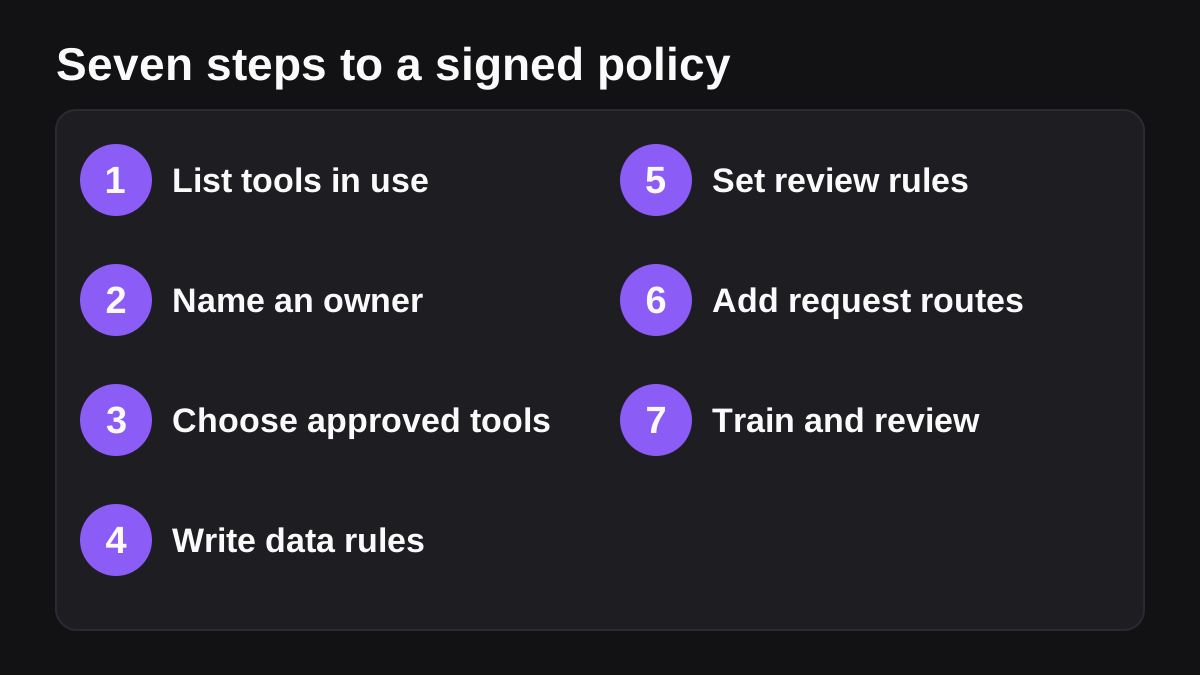
- List what people already use. Ask in a team channel, or run a short survey. Include browser extensions and AI features inside tools you already pay for. Expect surprises: NIST guidance says policies should cover both deployed and third party AI systems [2].
- Name the owner and the escalation point. One person owns the policy. The founder or managing director is the backstop.
- Choose the approved tools. Keep the list short. For each, write what it may be used for and which data tier it can handle. If you want a record of each tool's owner and purpose, NIST's guidance also calls for an inventory of AI systems [2].
- Write the data rules. Use the three tiers above. Put real examples next to each.
- Set the human review rules. Decide what a person must always check before it leaves the company. The human in the loop post covers where to draw that line.
- Add the request and reporting routes. Say how to ask for a new tool, and how to report a mistake. The Michigan SBDC includes a process for requesting new AI tools in its core list [6]. NIST also asks organizations to have policies for reporting and documenting incident response [2].
- Train, sign and schedule a review. Run a short session, have people acknowledge the policy, and put a review date in the calendar.
What should the policy say about training and review?
Training is part of the policy, not an extra. In the European Union, Article 4 of the AI Act requires providers and deployers of AI systems to take measures to build AI literacy among their staff and others who use AI on their behalf, fitted to their knowledge, experience and context of use. It has applied since 2 February 2025 [7]. The same article says the Commission and member states must support companies in meeting this duty, especially smaller ones [7]. Whether or not you operate in the EU, it is a sensible standard: teach people what the tools can and cannot do before you hold them to rules.
Keep training short and concrete. Walk through five real examples of green, amber and red requests. Show how a wrong AI answer looks. Tell people exactly where to report a problem.
For review, remember that IBM found only 34% of organizations with governance policies perform regular audits for unsanctioned AI [3]. A review on a schedule is what makes a policy more than a document. Every six months, check three things: what tools are in use, what has been reported, and whether any rule is being ignored because it is impractical.
What mistakes make AI policies fail?
Most failures are about the policy being hard to follow, not about being too lenient.
- It is too long. A twelve page document will not be read. Keep the first page to the data tiers, the approved tools and the review rule.
- It bans everything. A blanket ban with no approved alternative sends use out of sight. Samsung framed its own restriction as temporary while it built safer ways to work [5].
- It names tools instead of principles. Tools change monthly. The Michigan SBDC recommends writing around your overall approach rather than one tool [6]. Put tool names in a register you can update without rewriting the policy.
- It has no owner. Without a name, nobody answers questions.
- It punishes honest mistakes. If reporting a slip gets someone in trouble, people stop reporting. Separate honest errors from deliberate breaches.
- It never changes. NIST says its framework is intended for voluntary use and is being revised [1]. Rules around AI are moving, so schedule reviews.
Where does an AI employee fit into the policy?
If you use an AI employee, meaning an agent that takes jobs in Slack or Teams and works in the tools you connect, the policy needs a few more lines. Name who may give it jobs, which tools it may connect to, and which actions need approval. For example, Wopie pauses sensitive actions for a person to approve and keeps an audit trail of what it did, as described on its security page. Whatever tool you use, write the same three rules in your policy: it gets the narrowest access, a person approves anything that leaves the company, and the activity is logged where you can read it. See how to onboard an AI agent like a new hire for a staged rollout.
What to do next
Do this in the next week.
- Post a message in your team channel asking which AI tools people use for work, with no blame.
- Pick an owner and write their name at the top of a new one page document.
- Draft the three data tiers with five examples each, taken from your own work.
- List approved tools and the data tier each may handle.
- Add the human review rule and the reporting route.
- Hold a thirty minute walkthrough, collect acknowledgments and set a review date six months out.
A short policy that people read beats a thorough one that nobody does. Start with one page, check it against real work, and improve it each review.
Autonomous, not unsupervised.
Approval gates, scoped access and a full audit trail. See how Wopie keeps people in control.
See how Wopie stays safeSources
- [1]AI Risk Management Framework · National Institute of Standards and Technology (NIST) · accessed Nov 5, 2026
- [2]Govern - AIRC · NIST AI Resource Center · accessed Nov 5, 2026
- [3]IBM Report: 13% Of Organizations Reported Breaches Of AI Models Or Applications, 97% Of Which Reported Lacking Proper AI Access Controls · IBM Newsroom · accessed Nov 5, 2026
- [4]AI at Work Is Here. Now Comes the Hard Part · Microsoft Work Trend Index · accessed Nov 5, 2026
- [5]Samsung bans use of generative AI tools like ChatGPT after April internal data leak · TechCrunch · accessed Nov 5, 2026
- [6]Acceptable use of AI · Michigan Small Business Development Center · accessed Nov 5, 2026
- [7]Article 4: AI literacy | EU Artificial Intelligence Act · EU Artificial Intelligence Act · accessed Nov 5, 2026