Tasks to delegate to AI: which jobs to give an AI employee first
The best tasks to delegate to AI first are repeating, cross tool and easy to check. Here is how to pick your first job, what to hold back and a four week plan.
By the Wopie team · October 15, 2026 · 9 min read
Listen to this article· 11 min

The best tasks to delegate to AI first are the ones that repeat on a schedule, pull from more than one tool, and can be checked in a few minutes. A weekly pipeline report, a set of follow-up emails for quiet deals and a month-end pack all fit. A one-off strategy decision does not.
Start with one job like that, let a person approve the output, and measure the time it gives back. This guide shows you how to spot those jobs, which ones to hold back for now, and a four week plan you can run in a Slack or Microsoft Teams channel. It is general information, so adapt it to your own team and rules.
Why start with a small, boring job?
Most small teams do not have a shortage of ideas for AI. They have a shortage of time. In Microsoft's 2025 Work Trend Index, 80 percent of the global workforce said they lack the time or energy to do their work, while 53 percent of leaders said productivity must rise [2]. The same report says employees are interrupted by a meeting, email or ping roughly every two minutes of the workday [2].
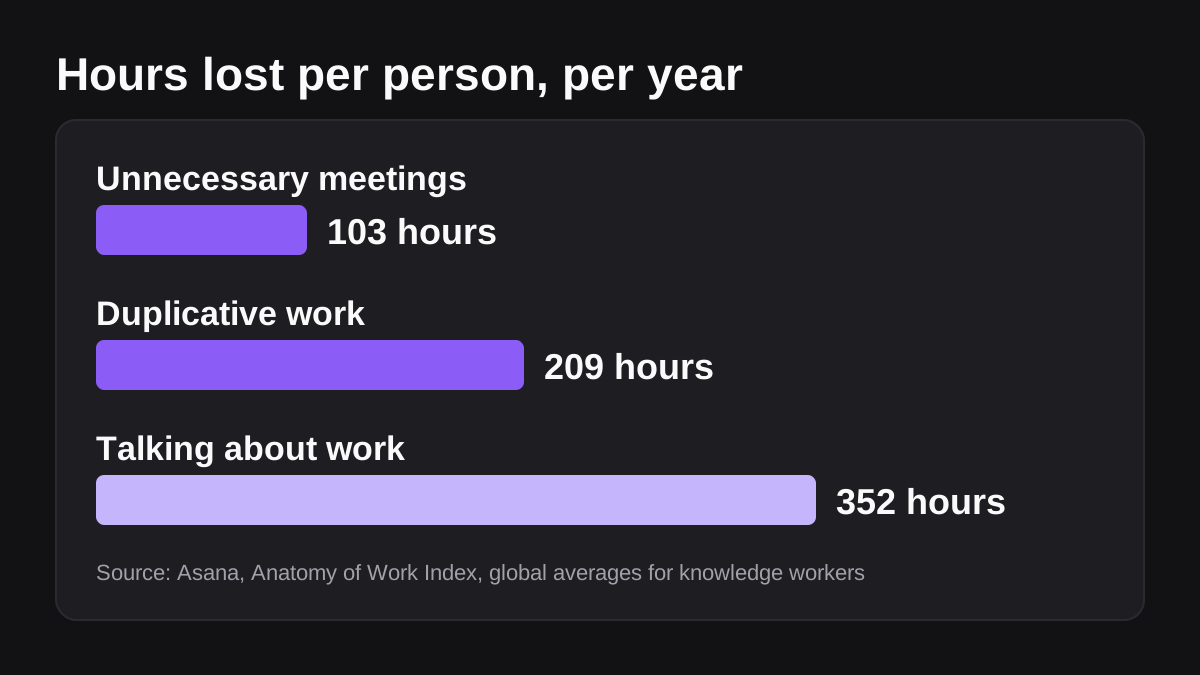
Much of that load is not the work itself. Asana's Anatomy of Work Index says knowledge workers spend 60 percent of their time on work about work [4]. That means status updates, searching, chasing and rebuilding things that already exist. Per person per year, Asana reports 103 hours in unnecessary meetings, 209 hours on duplicative work and 352 hours talking about work [4].
People are ready to hand some of this over. Microsoft's earlier survey found that 70 percent would delegate as much work as possible to AI to lighten their workload, and 76 percent would be comfortable using AI for administrative tasks [3]. Slack reported that its own AI saved users 97 minutes a week of administrative time, although its CEO also noted that people were still focusing on the work of work [6].
So the opening move is not to find the most impressive thing AI can do. It is to find the most repetitive thing your team does, and take that off their plate. If you want the background on what the software actually is, read what an AI employee is first.
What makes a task a good first job for an AI employee?
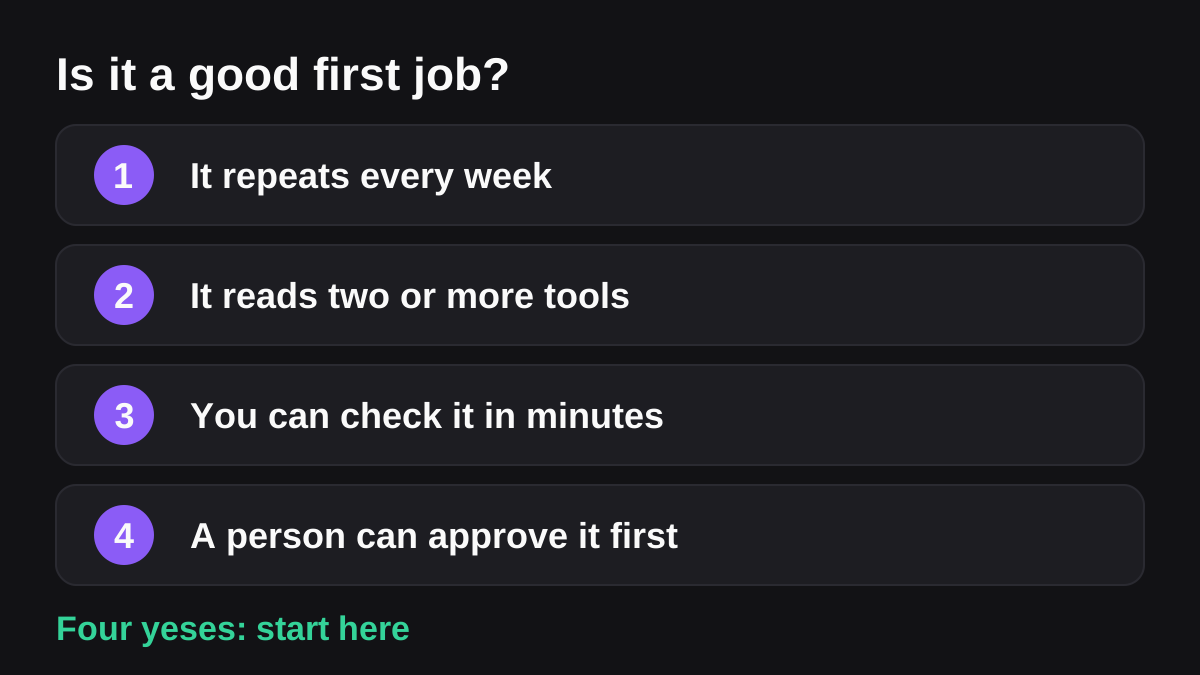
Four tests do most of the work. A task that passes all four is a safe place to begin.
It repeats
A job that happens every week gives you many chances to improve the instructions, and the time saved adds up. A job that happens once a year never pays back the setup. Slack's documentation describes agents as autonomous, goal-oriented apps that can reason, use tools and keep context across conversations [5]. Repetition is what lets that context build up.
It reads from several tools
If the whole job lives in one app, a built-in feature or a simple rule may be enough. Anthropic's advice is to find the simplest solution possible and only add complexity when needed [1]. The jobs that need an AI employee are the ones where someone currently copies numbers from a CRM, a payment tool and a doc into one place. Microsoft makes a similar point about combining approaches: a workflow can call an agent to complete a step, which gives you the predictability of automation with the flexibility of AI [7].
You can check the result quickly
Anthropic points out that coding and customer support work well for agents partly because success can be measured, for example by passing tests or by a resolved conversation [1]. Your equivalent is a report where the numbers can be traced to a source, or a draft you can read in two minutes. If checking the output takes as long as doing the job, it is the wrong first job.
A person can approve it before it matters
Anthropic describes agents that pause for human feedback at checkpoints or when they hit blockers [1]. Microsoft likewise lists human-in-the-loop controls as part of its workflows [7]. Pick a task where that pause is natural: the report is reviewed before it posts, the email is read before it sends. Costs and mistakes also grow with autonomy, since Anthropic notes that autonomous agents mean higher costs and the potential for compounding errors [1]. A review step keeps that in check.
Which jobs should you hand over first?
Here are the jobs that most often pass the four tests, drawn from the sort of recurring work Wopie's own examples cover. Each row reads on its own.
| Job | What it replaces | Why it works first | Who approves it |
|---|---|---|---|
| Weekly report | Copying numbers from HubSpot, Stripe and a doc into a summary | Same shape every week, easy to trace each number | The person who owns the report |
| Follow-ups for quiet deals | Scrolling the CRM and writing the same email in different words | Drafts are quick to read, each deal has an owner | The deal owner, before anything is sent |
| Decision brief | Asking five people for updates before an exec meeting | Pulls scattered updates into one page with owners | The meeting organizer |
| Month-end pack | Reconciling invoices against payouts and building the checklist | Rule-based, clear pass or fail, and large items are flagged | Finance lead, for anything above a set threshold |
| Support reply drafts | Writing first replies to routine tickets | Resolution is measurable, humans keep the hard cases | A support lead |
| Campaign audit | Pulling channel results into one comparison | Repeats on a schedule, reads several tools | The marketing lead |
Notice that every row ends with a named person. That is deliberate. An AI employee works best when each job has an owner who still decides what leaves the building.
A quick example: the weekly report
Take a sales manager who spends Monday morning building the pipeline report. They open the CRM, export deals, check payments in Stripe, read last week's notes, then write five bullet points and post them. In a Slack channel you could ask Wopie to build the report from HubSpot and Stripe and post it to the leadership channel before standup. It reads the tools, writes the finished report and waits for the manager to approve before it posts. The manager still owns the report. They just stop assembling it.
Which tasks should you not delegate yet?
Some work is a poor fit, at least for the first month. Holding it back is not a verdict on the technology. It is about risk and about how fast you can learn.
- Anything with legal, tax or employment consequences. Use AI to prepare the material, but keep a qualified person on the decision. This guide is general information, not advice for these areas.
- One-off, high-stakes decisions. You will not get repeat runs to learn from, and a wrong answer is costly.
- Sensitive conversations. A customer complaint that could turn into a lost account, or a performance discussion, needs a person.
- Work with no clear source of truth. If two tools disagree and nobody knows which wins, the AI will not settle the argument. Settle it first.
- Jobs you cannot describe. If a good colleague would need a week of shadowing to learn it, write it down before you hand it over.
- Anything that sends or spends without review. Early on, every outward message, payment or change to customer data should wait for a person.
Slack tells developers to apply best practices around trust, transparency and bounded autonomy when building agents [5]. For a buyer, bounded autonomy means you decide the limits: which tools it can read, which actions need approval, and where its work shows up. Wopie's approval gates and audit trail are built around that idea, so you can see what was done and who signed it off.
How do you pick and run your first delegated task?
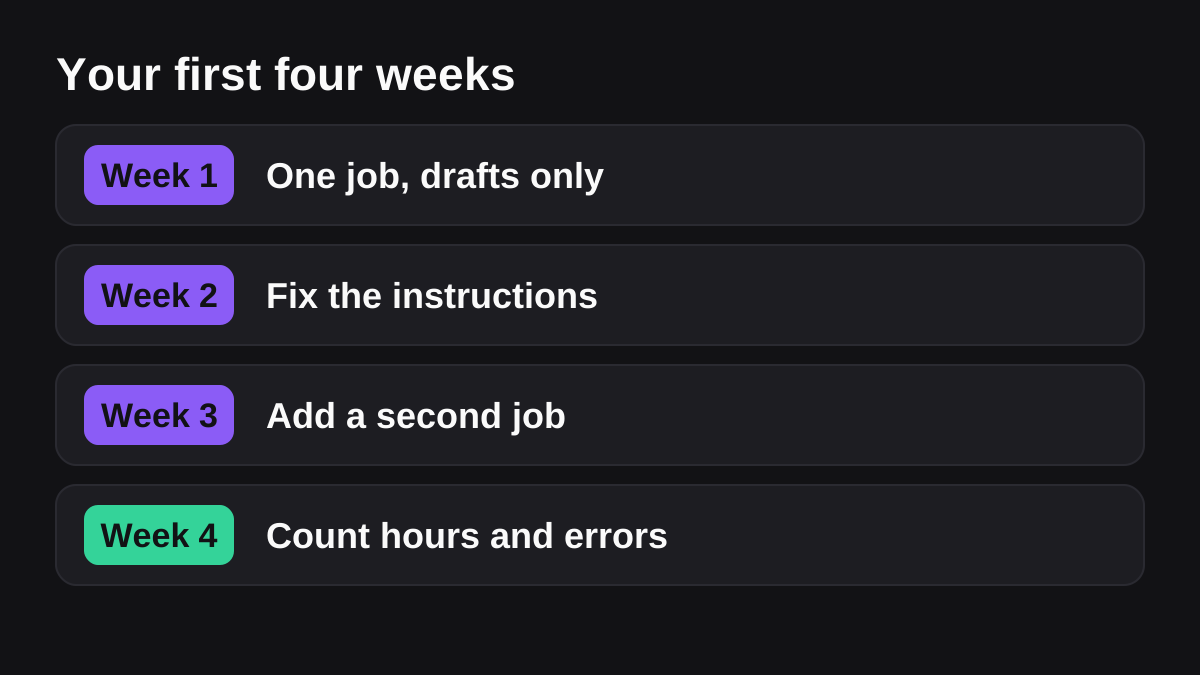
Use this sequence. It takes about an hour of planning and a month of running.
- List what repeats. For one week, ask each person to note every task they do more than once. Do not judge yet.
- Score each task with the four tests. Repeats, reads several tools, quick to check, easy to approve. Keep the ones with four yeses.
- Pick the one that wastes the most time. Where numbers help, count the minutes per week. Microsoft's guidance is to treat digital employees like team members: onboard them, assign ownership and measure their performance [2].
- Write the job down like a brief. Say what the finished output looks like, which tools to read, who approves it and when it is due. A good brief is two or three paragraphs, not a manual.
- Run it with approval on. Compare the first output with how you do it today. Note every difference.
- Fix the instructions, not just the output. If a number was wrong, say which source wins next time. Then run it again.
- Measure after a month. Count the hours saved, the corrections you made and anything that surprised you. Then decide whether to add a second job.
You can run this in the channel where the work already happens. Wopie takes jobs from a mention in Slack or Microsoft Teams, reads connected tools such as HubSpot, Stripe and Notion, and shows an estimate of the credits a task will take before it starts. See the Slack and Teams pages for how that looks, and the list of integrations for the tools it can read.
How do you know it is working?
Judge the first month on four simple measures rather than on a feeling.
| Measure | How to count it | Good sign |
|---|---|---|
| Time saved | Minutes the owner used to spend each run, minus minutes spent reviewing | Review takes a fraction of the old time |
| Corrections | How many facts or sentences the reviewer changed | Falling each week |
| On-time delivery | Did the output arrive when promised | Every run |
| Trust | Would the owner be happy to skip a check on low-risk parts | Yes, for some parts |
Be honest about the second row. Early on, corrections are normal. What matters is the trend. If they do not fall after a few runs, the brief needs work, or the job is a poor fit.
Also watch what people do with the time. Slack's CEO told Fortune that workers were still focusing on the work of work [6]. Time saved only matters if it moves to something better, so tell the team what you want them to do with it.
Finally, compare cost to value. The credits a job uses are the running cost, and your own review time is the other cost. For a fuller method, see how to compare an AI employee's cost with a new hire, and the pricing page for how Wopie charges.
What to do next
Keep it small. This week:
- Ask your team to list their repeating tasks.
- Score each one on the four tests and pick a single winner.
- Name the person who will approve the output.
- Write the brief in a few short paragraphs.
- Run it with approval on for four weeks, then count the results.
If you would like to try this with a real job, you can start a pilot with Wopie in a channel you already use. Whatever you choose, begin with the task nobody will miss doing, and add the next one only when the first has earned your trust.
Hand Wopie the job that eats your week.
Delegate it in a channel. Wopie gathers the context, does the work and waits for your approval. The first $100 of work is on us.
Get started freeSources
- [1]Building effective agents · Anthropic · accessed Oct 15, 2026
- [2]2025: The year the Frontier Firm is born · Microsoft WorkLab (Work Trend Index Annual Report) · accessed Oct 15, 2026
- [3]Work Trend Index | Will AI Fix Work? · Microsoft WorkLab · accessed Oct 15, 2026
- [4]How Work About Work Gets in the Way of Real Work [2026] · Asana · accessed Oct 15, 2026
- [5]AI in Slack · Slack · accessed Oct 15, 2026
- [6]Slack's AI is saving users 97 minutes a week. But its CEO worries they won't know what to do with their extra time. · Fortune · accessed Oct 15, 2026
- [7]Overview - Microsoft Copilot Studio | Microsoft Learn · Microsoft · accessed Oct 15, 2026