What the EU AI Act means for companies using AI agents
What does the EU AI Act mean for businesses using AI? A plain guide to who is covered, the dates, AI literacy, fines and a six-step plan for small teams.
By the Wopie team · November 6, 2026 · 10 min read
Listen to the summary· 1 min

What does the EU AI Act mean for businesses using AI? If your company uses AI tools or AI agents at work, you are most likely a "deployer" under the Act. For most small teams that means three things: make sure your people understand the tools they use, never use the banned practices, and tell people when they are dealing with an AI. A longer list of duties applies only if you use AI for high-risk jobs, such as hiring.
This guide explains who the EU AI Act for businesses covers, which dates matter, what it asks of a small company using AI agents, and what the fines are. It also gives you a six-step plan you can finish in a week. It is general information, not legal advice, and rules and dates change, so check the official pages before you rely on any date here.
Does the EU AI Act apply to your company?
Probably, if you use AI and have any link to the EU. The Act covers deployers whose place of establishment is in the Union, or who are located there [7]. It also reaches providers and deployers in other countries when the output of their AI system is used in the Union [7]. So a US company whose AI agent writes content or decisions that are used by customers or staff in Europe can fall inside it.
A few uses are excluded. The list includes military, defense and national security uses, and purely personal, non-professional use [7]. Your Slack agent that chases invoices is not on the excluded list.
What is a deployer, and what is a provider?
A provider builds an AI system, or has one built, and puts it on the market. A deployer is an organization that uses an AI system under its own authority. Most small and mid-sized companies are deployers. If you build your own agent on top of a third-party model, you may be both, and the duties for providers are heavier.
Does it matter that an AI agent is "agentic"?
Not directly. The Act does not set special rules for agents as a type. It sorts AI systems by risk and by use. The Commission describes four levels: unacceptable risk, high risk, transparency risk, and minimal or no risk [1]. An agent that moves data between your CRM and a report can sit in the last two. The same agent used to screen job applicants would sit in a much stricter level.
What are the four risk levels, and where do your AI tools fit?
The Commission page sets out the levels like this [1]:
| Risk level | What it means | Everyday examples |
|---|---|---|
| Unacceptable | Banned outright | Social scoring, certain biometric identification |
| High | Strict duties for providers and deployers | Sorting CVs for recruitment, credit scoring for essential services |
| Transparency | People must be told they are dealing with AI | Chatbots, AI-generated content |
| Minimal or none | No specific rules | Spam filters, AI in video games |
Most of what a small team does with an AI employee or assistant falls into the bottom two rows. Drafting a weekly update, summarizing a support queue, preparing a month-end pack or updating CRM fields are not on the Commission's high-risk examples. That does not make them risk free in other ways, such as data protection or security, which this Act does not replace.
What is banned?
The Commission says nine practices are prohibited, including social scoring [1]. The ones most relevant to workplaces are worth knowing by name. Article 5 bans AI that infers emotions in the workplace and in education, except for medical or safety reasons. It also bans manipulative or deceptive techniques that materially distort behavior and cause significant harm, and exploiting vulnerabilities tied to someone's social or economic situation [8]. It bans systems that categorize people by biometric data to infer traits such as trade union membership [8]. If you are not doing any of these, this part of the Act will not trouble you, but it is worth confirming that no tool you buy does.
What counts as high risk?
For workplaces, the Commission points to uses such as sorting CVs for recruitment and credit scoring for essential services [1]. Those belong to what the Act calls Annex III uses, and the Commission says the Annex III dates, which include employment, education and biometrics, now sit at 2 December 2027 [1]. If you are using AI to rank, filter or decide about people, treat that as the cue to slow down and get proper advice.
Which dates matter in 2026 and 2027?
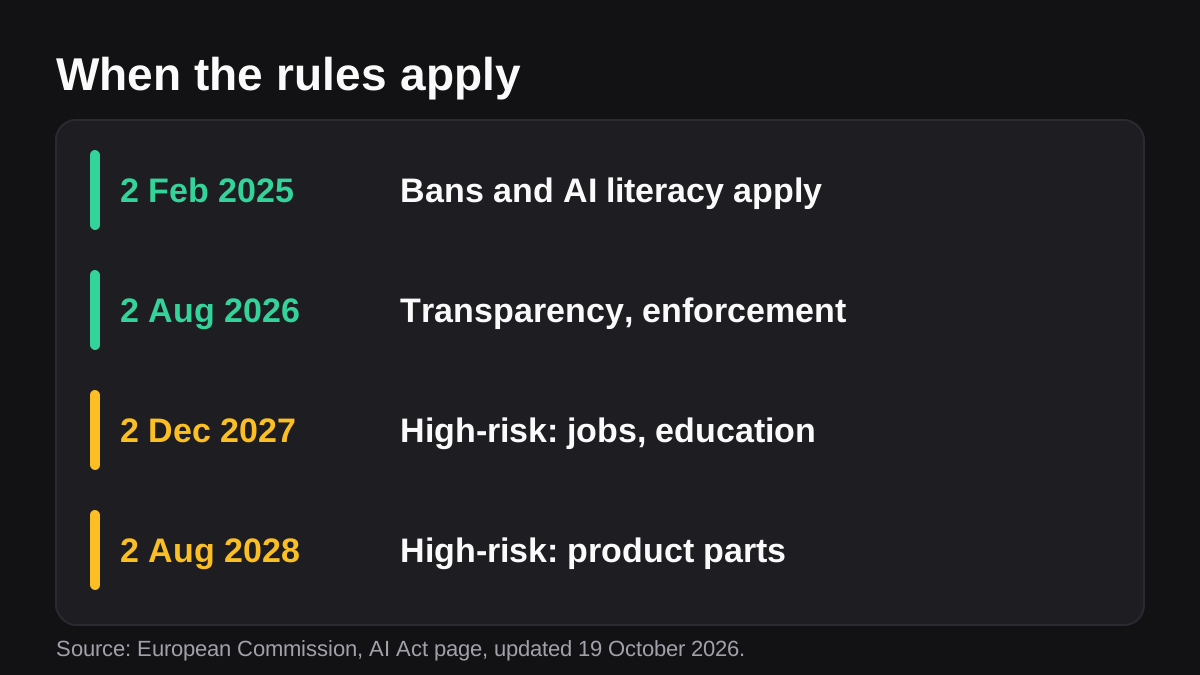
The Act entered into force on 1 August 2024, and its duties switch on in stages [1]. The Commission lists these dates [1]:
- Prohibited practices and AI literacy: from 2 February 2025.
- General applicability, transparency rules and enforcement by the AI Office and national authorities: 2 August 2026.
- High-risk uses under Annex III, such as employment: 2 December 2027.
- High-risk AI embedded in regulated products: 2 August 2028.
The later dates for high-risk uses came from what the Commission calls the AI Omnibus. It was adopted by the Commission on 19 November 2025, reached political agreement on 7 May 2026 and entered into force on 27 July 2026 [1]. In practice, that means that as you read this, the first two groups of rules already apply and the high-risk duties are a year or more away. Dates have moved before, so check the Commission page for the latest.
What is the AI literacy rule, and does it apply to you?
This is the rule most small companies will meet first. Article 4 says providers and deployers of AI systems must take measures to support AI literacy among their staff and others who operate or use AI systems on their behalf [3]. The measures should fit people's technical knowledge, experience, education and training, plus the context in which the AI is used [3].
The wording is practical. The duty is to do your best to reach a sufficient level of AI literacy, and the article states that it does not require you to guarantee any specific level [3]. It has applied since 2 February 2025 [1].
Does it cover ChatGPT-style tools?
Yes. The Commission's questions and answers say a company whose employees use ChatGPT for tasks such as writing advertising copy or translating text still has to comply, and that staff should be told about specific risks such as hallucinations [2]. In plain terms, if your team uses AI at work, you have this duty.
Do you need a certificate?
No. The Commission says there is no need for a certificate, and that organizations can keep an internal record of trainings and other initiatives instead [2]. A short written note of who was trained, when, and on what is a sensible record to keep.
Who enforces it?
Supervision and enforcement of Article 4 begin on 2 August 2026, carried out by national market surveillance authorities under national law [2]. The Commission says enforcement is proportionate, and the factors include the nature and gravity of the infringement and whether it was intentional or negligent [2]. It also says that the AI Act itself creates no criminal offences and no right to compensation, though people harmed may be able to bring private claims under national law [2].
Is there help for small companies?
The Act tells the Commission and member states to support providers and deployers in meeting this duty, especially SMEs [3]. The Commission lists help such as European Digital Innovation Hubs, which can act as a first help desk on the Act, and an AI Skills Academy that began operating on 1 May 2026 [2]. It adds that copying examples from its repository does not automatically grant a presumption of compliance [2].
What do the transparency rules require?
Article 50 is about telling people when AI is involved. The Commission lists these transparency rules as applying from August 2026 [1], and the article text agrees [5].
Here is what it asks for in plain terms [5]:
- Systems built to interact directly with people must make clear that the person is dealing with AI, unless that is obvious to a reasonably observant person.
- Providers of systems that generate synthetic audio, images, video or text must mark the outputs in a machine-readable way so they can be detected as artificially generated.
- Deployers must disclose when image, audio or video content that resembles real people, places or events is AI-generated or manipulated.
- Deployers who publish AI-generated text to inform the public on matters of public interest must disclose it, unless a person has reviewed it and holds editorial responsibility.
Think about where this touches your day. A customer chat bot should say it is a bot. A marketing video that uses a synthetic voice resembling a real person should be labeled. A routine internal report that an agent drafts, and a person checks, is not a public interest publication. The information has to be clear and given at the latest at the first interaction or exposure [5].
What must you do if you use high-risk AI?
Only some companies need this section. If you use AI in a high-risk area, such as recruitment, Article 26 sets duties for you as a deployer. The article says it applies from 2 December 2027 for Annex III systems and 2 August 2028 for Annex I systems [6]. In summary, you must [6]:
- Use the system as the provider intends, following the provider's instructions.
- Assign human oversight to people with the necessary skills, training, authority and support.
- Make sure input data you control is relevant and sufficiently representative.
- Monitor operation, and if you suspect a risk, notify the provider and the authority and suspend use.
- Keep the automatically generated logs you control for at least six months, unless other law requires otherwise.
- Inform workers' representatives and affected workers before putting the system to use at work.
The Commission adds that deployers of high-risk systems must still ensure staff are trained for human oversight [2]. The practical lesson for any company is useful even outside high-risk areas: approvals, named reviewers and logs are the same controls we describe in our posts on human in the loop AI and giving an AI agent access to company tools.
How big are the fines?
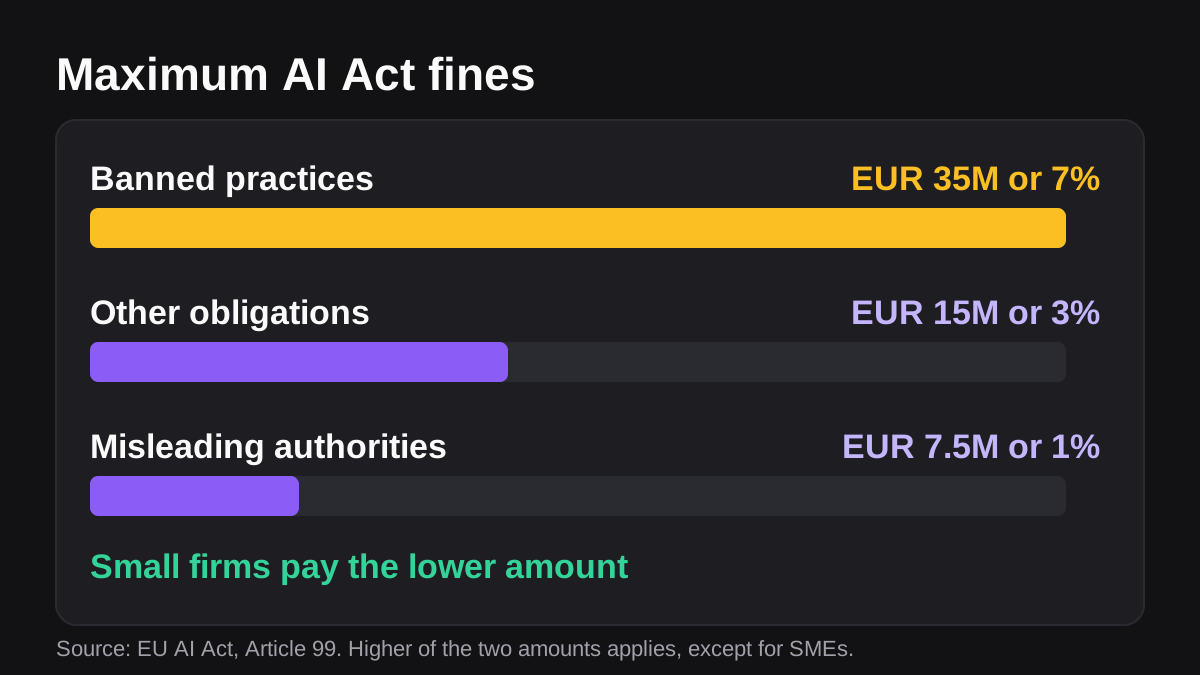
Large, but with protection for small firms. Article 99 sets these maximums [4]:
| Breach | Maximum fine |
|---|---|
| Prohibited practices | EUR 35 million or 7% of worldwide annual turnover, whichever is higher |
| Other obligations | EUR 15 million or 3% of worldwide annual turnover, whichever is higher |
| Incorrect, incomplete or misleading information to authorities | EUR 7.5 million or 1% of worldwide annual turnover, whichever is higher |
For SMEs and start-ups, the lower of the two amounts applies [4]. The numbers are ceilings, not what a first-time small offender should expect. The Commission says enforcement is proportionate [2]. But the first row is a strong reason to check what any tool you buy actually does.
How do you prepare in six steps?
You do not need a legal team to get most of the way. This plan takes a small company about a week.
- List every AI tool in use. Include the ones people signed up for themselves. Write down who uses each tool and for what job.
- Sort each use by risk level. Use the four levels in the table above [1]. Mark anything that touches hiring, firing, pay, credit or education as a flag for closer review.
- Check for banned practices. Confirm that no tool infers employee emotions, scores people on behavior, or tries to manipulate them [8].
- Train your people and keep a record. Cover what the tools do, where they go wrong, such as hallucinations, and what is not allowed. Keep a simple log of who attended [2].
- Add disclosure where AI talks to people. Label chat bots, synthetic media and published AI text as the rules describe [5].
- Put approvals and logs around anything sensitive. Name who approves what, and keep a record of what the AI did. Our guide to writing an SOP an AI agent can follow shows how to write those rules down.
A tool can make some of these steps easier. For example, Wopie is an AI employee that takes jobs in a Slack or Teams channel, reads the tools you connect and pauses anything sensitive for human approval. Its security page describes an audit trail of requests, outputs and approvals. That helps with the record keeping side of step six, but it does not make you compliant by itself. The duties in this Act sit with you as the deployer, whatever tool you choose.
What to do next
Spend one hour this week on these three things:
- Make the list of AI tools in use and who owns each one.
- Pick one person to own AI literacy training and the record of it.
- Read the Commission's AI Act page for the current dates, and ask a qualified adviser about anything that touches hiring or decisions about people.
Most small teams will find that their obligations are lighter than the headlines suggest. The work is mostly knowing what you use, teaching people to use it well, and keeping a record. Start there.
Autonomous, not unsupervised.
Approval gates, scoped access and a full audit trail. See how Wopie keeps people in control.
See how Wopie stays safeSources
- [1]AI Act | Shaping Europe's digital future · European Commission · accessed Nov 6, 2026
- [2]AI Literacy - Questions & Answers | Shaping Europe's digital future · European Commission · accessed Nov 6, 2026
- [3]Article 4: AI literacy | EU Artificial Intelligence Act · artificialintelligenceact.eu · accessed Nov 6, 2026
- [4]Article 99: Penalties | EU Artificial Intelligence Act · artificialintelligenceact.eu · accessed Nov 6, 2026
- [5]Article 50: Transparency Obligations | EU Artificial Intelligence Act · artificialintelligenceact.eu · accessed Nov 6, 2026
- [6]Article 26: Obligations of Deployers of High-Risk AI Systems | EU Artificial Intelligence Act · artificialintelligenceact.eu · accessed Nov 6, 2026
- [7]Article 2: Scope | EU Artificial Intelligence Act · artificialintelligenceact.eu · accessed Nov 6, 2026
- [8]Article 5: Prohibited AI Practices | EU Artificial Intelligence Act · artificialintelligenceact.eu · accessed Nov 6, 2026